
Will A Change At The Top Save Boeing?
Can Kelly Ortberg save one of the crown jewels of American aerospace?


A chance meeting
It was November of 2018 and a friend of a friend introduced me and another Epirus cofounder to a former CEO of an defense prime (who will remain nameless, but obviously not Boeing). He’d invited us over to his house for coffee and he knew that I had just come from there, so he thought he could be frank with his thoughts on the company:
“Seriously, what the fuck is going on over there (at Boeing)?! It used to be that when there was a problem in Seattle with one of the airplane programs, they would send over the St Louis guys (or vice versa) to fix it - or some of the Hughes or Rockwell guys from CA and they’d get back on track. Now it looks like they don’t know how to do anything anymore.”
I replied: “Well sir, to be frank, they’ve completely lost the sauce on systems engineering. I saw it when I was there: too many engineering leaders who couldn’t integrate the pieces and force even obvious decisions unless they had 100% of the information because they were too afraid of the bean counters punishing them for making the wrong one. They’d blow millions in cost and months in schedules to be 100% certain they were making the right decision and then the product would fall apart through entropy.”
He finished my thought: “Penny wise, pound foolish. Accountants not engineers deciding what’s best for the product.”
“Precisely.”
* * *
Will new leadership be enough to turn the ship around?
This past week, Boeing announced that it was hiring former Rockwell Collins CEO Kelly Ortberg to replace the existing CEO Dave Calhoun. For the first time in nearly five years, a former engineer was back at the helm of one of America’s most important engineering companies - one which contributes as much as 1% to US GDP through it’s airplane production. Ortberg has a reputation as a practical, down to earth guy who believes in leveling hierarchy and rolling up his sleeves to make things better.
To put it almost as bluntly as the former CEO above did for me though: Ortberg is inheriting a huge mess - and it has been a huge mess for quite a while. Through decades of mergers with it’s failed rivals (Rockwell, MacDonnell Douglas, Hughes Satellite Systems), Boeing seems to have inherited the worst aspects of their cultures while excising some of the best virtues. On the commercial aircraft side, product lines like the 737 Max, Dreamliner and 777X that should be turning into cash cows by now have become sore points for customers due to a series of tragic accidents and execution failures related to excessive outsourcing and lack of expertise.
The Defense side of the house is similarly a mess: with an aloof and swollen executive staff at the top watches, scores of relatively low tech programs like KC-46 (a tanker aircraft which they’ve been building for 70 years), the CST-100 Starliner (they’ve been building manned spacecraft for 50 years) and Air Force One (a upgrade job for an airframe Boeing has built for 60 years) flounder due to basic blocking and tackling problems with their engineering manifesting themselves in manufacturing on programs they should be able to execute on with their eyes closed. This has caused billions of dollars of charges on these programs that weigh like a boat anchor on Boeing’s extremely long winding balance sheet.
In this piece I’m going to focus on how Boeing got here, with a little bit of perspective from my own experience (I worked at Boeing from 2014 to 2018 - a little short of five years in total). I’ll also finish with some concrete steps that I believe Ortberg could or will potentially take to right the ship.
OI honestly want Kelly Ortberg to succeed in turning around the company because I think America needs Boeing, but in order to do so he’ll need to confront some hard truths, change the culture to focus on longer term value and slaughter some sacred cows.
How the mighty have fallen
There was a time a generation ago when The Boeing Company was a dream employer for every aerospace engineering grad. Everyone aspired to be the next Joe Sutter, the legendary “configurator” (as us engineers call airplane designers) who designed the 747 and 737 and filled the sky with them. This included an Iowa farmboy (and future Boeing CEO) Dennis Muilenberg who packed up his car fresh out of school to go west to Seattle and hitch his wagon to its corporate star.

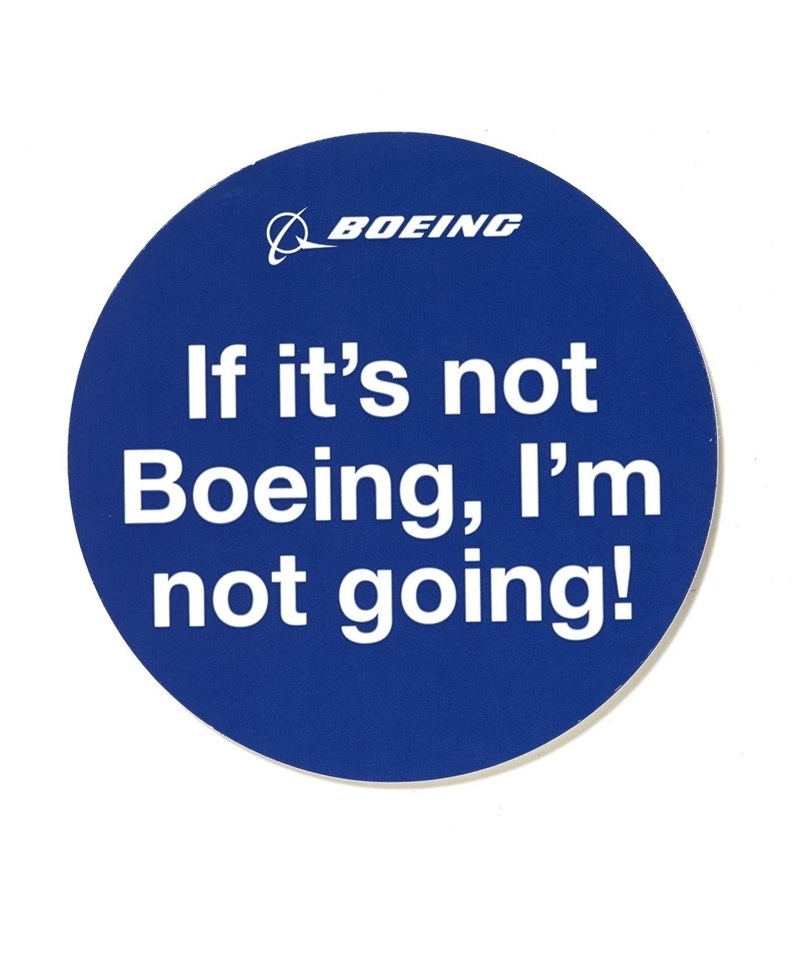
Why did two, almost three generations of engineers do this? It wasn’t just that what Boeing was building was exciting and cool then in the same way Hermeus’s hypersonic jets or SpaceX’s Starship are today. Boeing was known as a shop where the engineers ruled the roost and quality and engineering integrity trumped the bottom line. Stickers reinforced this throughout the cubicle farm and bumperstickers - the quality of the product was a cultural underpinning and source of pride.
How “Boeing lost the sauce on systems engineering”
Entire books have been written about the slow downfall of Boeing but I’ll try to focus on the biggest landmines here. TL;DR: The broad industry consensus is that the root cause of this mess was the badly structure merger with it’s failed and vanquished competitor McDonnell Douglas. In the course of the merger, McDonnel Douglas (MacDac) took over Boeing from within and refocused it away from sound systems engineering to a culture based on financial engineering and bean counting.
That broken culture, which put short term financials ahead of long term results, put Boeing in the position it is in today. This broken culture and bad executive leadership showed itself first in a series of contracting scandals. This was followed by an engineering brain drain as the company focused obsessively on rates and financial engineering, while outsourcing essential skills and production. Then it stopped listening to its customers properly and finally major systems engineering errors started to proliferate in mature programs in production or after launch (Tanker, Air Force One, Max, Dreamliner and CST-100 Starliner).
The broad industry consensus is that the root cause of the mess Boeing is in today was the badly structured merger with it’s failed and vanquished competitor McDonnell Douglas, which took over the host organization from within and refocused it away from a cultural rooted in sound systems engineering to one based on financial engineering and bean counting.
Boeing was able to cruise for a long time - almost two decades post merger- with financials that looked great because the production and development cycle for its products was so long. Further, through the use of a unique to aerospace accounting practice called program accounting they were able to submerge hidden risk costs that they were bow waving on programs. It was sitting on several time bombs and it was only a matter of time before they started to go off.
Here’s a little history for the uninitiated.
Too many badly structured mergers let the failed cultures dominate
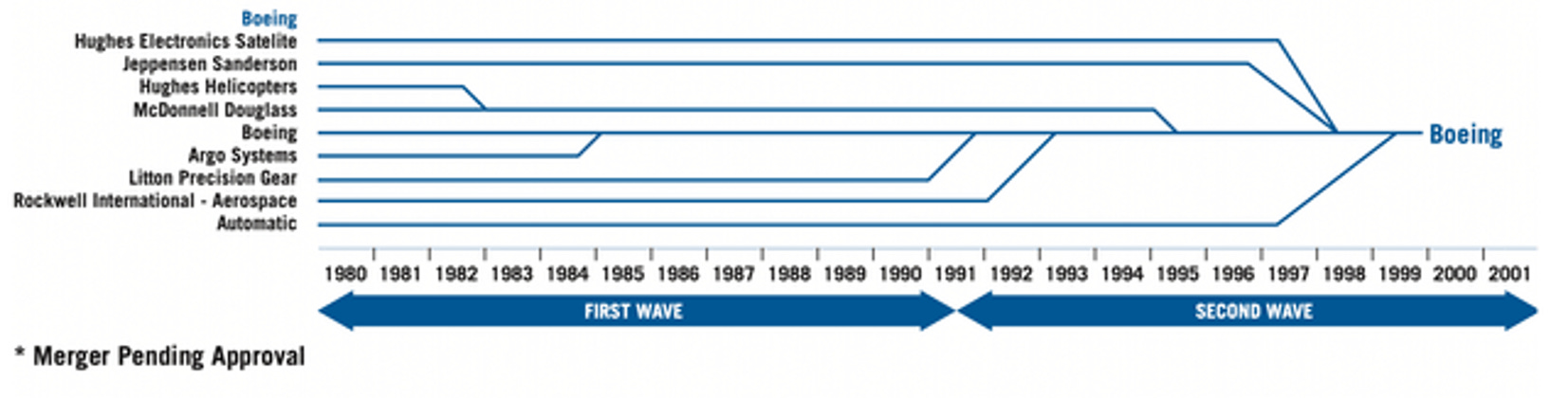
Partly as a result of the last supper in the 90s, where the DoD actively encouraged all the defense suppliers to consolidate to help reap the “peace dividend” Boeing grew massive from mergers with a number of it’s already large competitors (as shown in Figure 3 above). Some of these mergers were good things for Boeing: the addition of Hughes Space & Communications and Rockwell put a lot of space expertise from both the satellite division that invented the Geosynchronous satellite (Hughes) and the company that built the Space Shuttle (Rockwell) under the same roof as Boeing which was the prime for the International Space Station. Hughes Helicopters has for the most part thrived as part of Boeing with the Apache and Chinook lines being cash cows for the corporation and venerated workhorses for the Army, Marines and dozens of international customers.
But the 1997 merger with McDonnell Douglas, is a cautionary tale in how to not let a vanquished competitor take over through merger. This merger left the Boeing company infected by a culture myopically focused on near term financials led by flawed figures right out of a Tom Wolfe novel.
McDonnell Douglas was Boeing’s only surviving commercial airplane rival on the domestic side and now they were vanquished. It was no surprise: “MacDac” had spent much of the 80s and 90s warming the house by burning the furniture: focusing on penny pinching and financial engineering to support stock buybacks, while simultaneously leading a 60% reduction in R&D, cutting CapEx investment, hollowing out it’s engineering base and pretty much abandoning all future commercial airplane development ceding the field to Boeing and Airbus.
“McDonnell Douglas has bought Boeing with Boeing’s money.” - Former Boeing CEO T. Arnold Wilson
MacDac’s management, which had driven the company into the ground through notorious penny pinching and bean counting at the expense of their products, were forced into a sale by Wall Street and the government as it was rapidly becoming apparent that the company was headed towards permanent unprofitability and the government didn’t want to lose it’s 3rd largest combat aircraft producer.
But MacDac’s management, specifically Chairman John McDonnell and CEO Harry Stonecipher, knew how to play a weak hand amazingly well. The two executives took Boeing’s CEO at the time, Phil Condit, for a ride and got him to agree to an enormously high price tag of over $13 billion - fully 25x earnings, which is almost software like valuations for a company on the verge of unprofitability. Furthermore, the deal gave four of twelve board seats to former MacDac executives or board members. It was literally the worst deal conceivable and became a running joke within the company, yet amazingly the Boeing board approved it. As word spread of the turkey of a deal Condit had signed, former Boeing CEO T. Arnold Wilson famously riffed to some engineers in the parking lot of the headquarters building, “McDonnell Douglas has bought Boeing with Boeing’s money.”
McDonnell Douglas: A Broken Culture
McDonnell Aircraft Corporation was culturally rooted inaspects of Taylorite management and extreme industrial-era penuriousness. Jim McDonnell, the founder of the company had a reputation as one author put it as “A self-proclaimed “practicing Scotsman,” Mr. Mac once handed out egg timers to remind his executives to rein in their long-distance calls.” I recall hearing one story in the halls of St Louis about how draftsmen in the 60s and 70s were evaluated by their managers at the end of the day based not on the quality of their work but how much they had worn down their drafting pencils when they turned them in that day.
I recall hearing one story in the halls of (McDonnell Douglas) St Louis about how draftsmen in the 60s and 70s were evaluated by their managers at the end of the day based not on the quality of their work but how much they had worn down their drafting pencils when they turned them in at the end of their shift.
In 1967, the McDonnell Aircraft Corporation (Mac) merged with the Douglas Aircraft Corporation (DAC) to form McDonnell Douglas, in a marriage of convenience where they believed DACs commercial aircraft business would provide some hedge against lean cycles in defense for MAC.
With Jim McDonnell’s death in 1980, a new generation took over inspired by Jack Welch but with McDonnell’s same penny pinching impulses- thereafter MacDac developed a cutthroat reputation for doing whatever was required to win, including walking right up to, or sometimes crossing the line of legality and ethics. This contrasted heavily with the more collegial, product quality focused engineering culture at Boeing. The executive injection from MacDac and it’s disproportionate control post merger make the MacDac folks dominant in a lot of situations and it wasn’t a good thing.
Separate Leadership from Engineering
One other major mistake Boeing made in 2001 (also by Phil Condit who gave away the farm in the merger) was decoupling the headquarters from engineering and manufacturing in Seattle to Chicago. This created a barrier between the corporate leadership and the engineering and manufacturing of its commercial airline products. It further doubled down on this policy of separating leadership from product in 2016 when it moved it’s headquarters for its defense unit from St Louis (where it built airplanes and missiles and bombs in St Charles, MO) to DC. In 2022, it went even further, moving the corporate headquarters to DC as well - putting 6 hours flight and 3 times zones between it’s main product line and it’s leadership.
Darlene Druyen and the Tanker Scandal

It wasn’t long after the acquisition that Boeing found itself stepping into a number of unforced errors related to MacDac’s “anything to win” tactics backfiring. The most famous one (which has become the underlying example in all defense ethics training going forward) was the scandal surrounding the tanker competition, where Boeing’s CFO Michael Sears (a MacDac transplant) offered jobs to then head of Air Force Acquisitions Darleen Druyen and her children, in exchange for favorable treatment on several contracts, most notably tanker. Both Sears and Druyen served jail time for this.
Also in this era, Boeing admitted guilt in illegally obtaining information from an Air Force official which it used in a launch procurement bid for the Air Force and NASA under the EELV program, which it paid over $600M in civil and monetary penalties to settle and saw three of it’s divisions barred for 20 months from bidding on government contracts. This boondoggle eventually led to the creation of the United Launch Alliance (ULA) joint venture with Lockheed to clear the air of litigation. ULA has been circling the drain the last ten years as SpaceX has grown from an upstart to the majority of the launch market once it succeeded in its 2014 lawsuit against the Air Force which forced it to compete its commercial launch contracts, clearing a path for the much more efficient launch market we have today and putting United Launch Alliance in Corporate chemotherapy.
Boeing eventually won a recompeted KC-46 tanker competition, the same one that Druyen went to jail for illegally selecting Boeing for, by “buying into the program” in 2011. This came after years of delays and stiff competition from Northrop teaming with Airbus, but numerous engineering errors caused by concurrency of manufacturing and engineering to meet schedule, and lack of solid systems engineering have plagued the program resulting in over $5B in charge offs since. Major defects involved redundancies in the primary control harness for the aircraft and the 3D optic used by the refueling boom operator in the cockpit caused massive rework and lots of unplanned and expensive testing that ran late into product and rework of delivered aircraft, as traveled work leaked from one phase of the product lifecycle to the next.
So much money has been bled on this program it’s unclear if Boeing will ever be profitable on the domestic side (though it may make the money back on future military upgrades and sustainment).
Meanwhile, examples of ethics issues in bidding with the government kept happening, again and again in spite of dozens of hours of compliance training heaped on subordinates. The old MacDac executive culture of “win at any cost” always looking for an inside insight kept leaking through. As recently as 2020, Boeing space executives were investigated on charges that they used insider information on a NASA Lunar Lander contract to advance their decision made headlines, resulting in the resignation of a senior NASA official, the firing of one Boeing lawyer and several mid level employees.
Management openly hostile to engineering and labor
Former MacDac CEO Harry Stonecipher, who succeeded Condit as CEO after Condit was forced to step down in 2003 in the wake of the Druyen scandal, was openly hostile with the engineering workforce who he viewed primarily as a cost center. The company began an unusual fixation on cutting rates, partly to enable their strategy of “buying the program” through aggressive lifetime cost pricing to succeed. Minimal accommodation was made for risk and the concept of “best value” oftentimes went out the window.
Between 2005 and 2011, Boeing Defense went through a period of huge program cancellations such as the Future Imagery Architecture (FIA) program for the National Reconnaissance Office, Future Combat Systems for the Army, the TSAT constellation for the Air Force and problems with the Delta III rocket program and other large programs due to low performance and severe underbidding practices that had come back to bite them after years of heroic effort. Tens of billions in future bookings evaporated from the defense unit in less than five years. This put further pressure on morale and the balance sheet.
Under Harry Stonecipher the decision was also made to start spinning out critical parts of Boeing’s component stack. First Spirit Aerosystems, the fuselage maker in Wichita KS, made famous for the “door plug” blowout incident was spun out in 2005 for $1.2B. Then the Rocketdyne engine unit was sold off to United Technology Corporation in the same year for $700M. Boeing was thinning out its in house component sub-system expertise to build up short term cash. Some of this was understandable in the wake of the post-9/11 bear market in air travel. But when it became clear air travel demand was increasing, they didn’t change course but continued the same philosophy.
This same hostility to engineering and the employee base that started under Stonecipher continued to proliferate under the CEO that succeeded him, Jim McNerney. McNerney had grown up in the cut-throat culture of GE and was a transplant from 3M who as CEO had earned himself a reputation as a “creativity killer” for bringing six sigma practices into the labs rather than leaving them on the manufacturing floor where they are more appropriate. He spent the bulk of his tenure fighting with the various unions very publicly as he resisted their efforts to drive up wages and retain previous benefits. He also tried to move their work out of Seattle and into other states like South Carolina. This further added to the pressure of the brain drain.
McNerney also continued the push for outsourcing critical parts of a design to save cost. This “thin prime” model of engineering had first been recommended by McKinsey in the 90s and was seen as a great way to maximize margins. The more of the work you could get off your balance sheet, the better for your cash flow. This was seen as risky by many in the industry and experience has proven them right. The 787 Dreamliner was $26 billion over its initial $6 billion development budget and 3 years behind schedule primarily due to supply chain issues and engineering issues.
“This is an engineering company. That’s been forgotten…A ruthless focus on cost is not a very good long-term vision for an engineering company.”- Richard Aboulafia, Teal Group (Aerospace Industry Analysts)
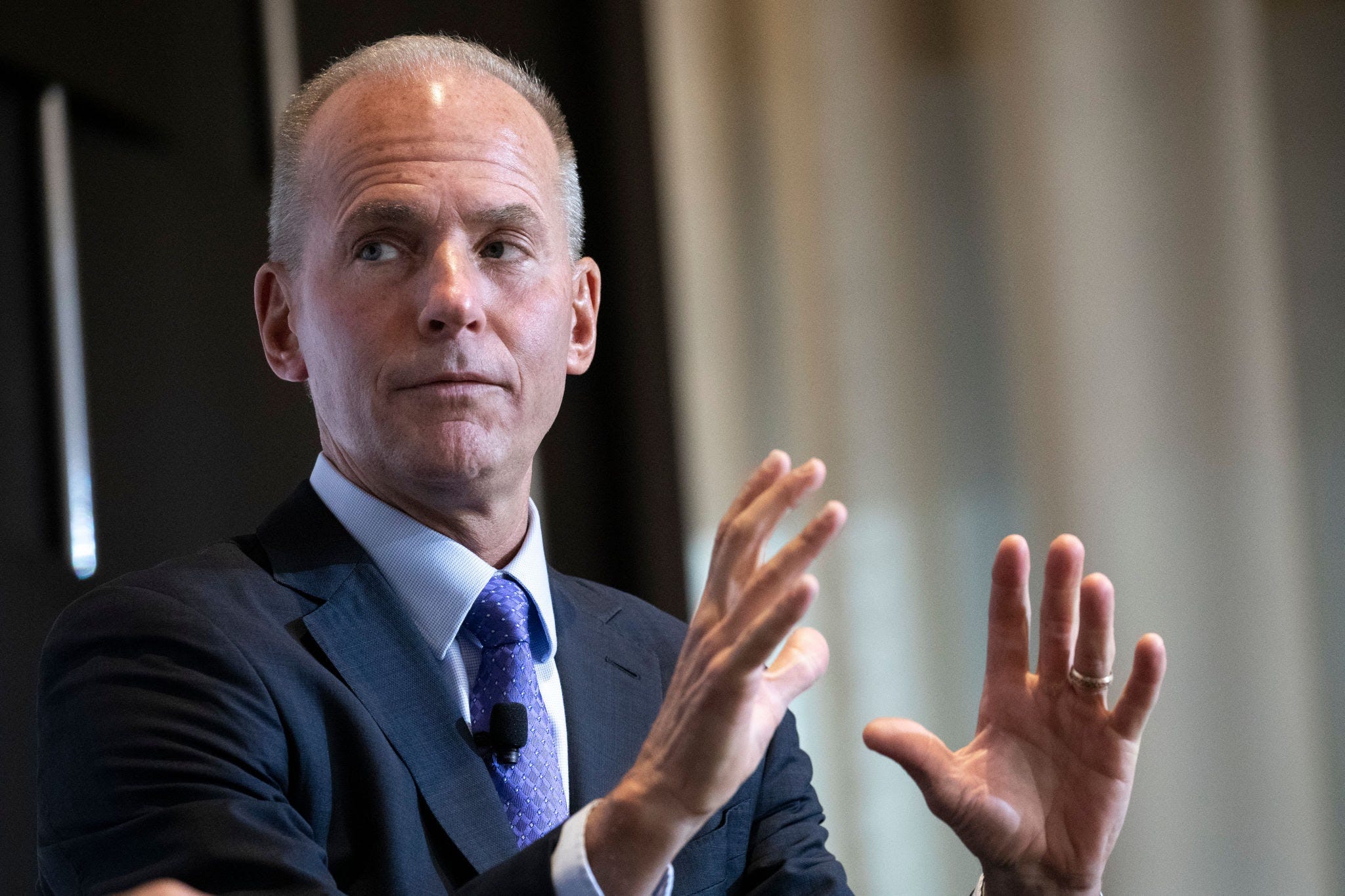
In 2015, Dennis Muilenberg, a Boeing lifer and supposedly an engineer’s engineer, who looked like a 1960s era astronaut and boasted that he biked 150 miles plus per week while drinking something like 6 diet mountain dews a day took the reins. The first couple years of his tenure saw record profits and bonuses as the fruits of the last decade of financial engineering hit the financial tailwinds of a global economy finally emerging from the great recession and the Dreamliner and Max reaching full production. The stock price neared an all time high and rank and file employee profit sharing reached over 6% of salaries (versus 3-4% in a typical year) in 2016.
Unfortunately Muilenberg didn’t know he was sitting on several timebombs and he eschewed from making radical cultural changes, but the risk check had already been cashed. In 2018 two Boeing 737 Max aircraft crashed into the ground at 300+ MPH within a couple months of each other due to a failure in it’s Maneuvering Characteristics Augmentation System (MCAS) control system meant to compensate for an unstable design, caused by adding oversized engines to the 737 to squeeze the last bit of range and efficiency out of an already overextended design. The training for the pilots had not been robust enough to give them awareness of this potential failure mechanism, then compensate for the failure and know how to overcome it and regain control of the airplane. As a result, 346 people perished.
In the wake of this tragedy, Muilenberg held a disastrous press conference where rather than having a full mea culpa and vowing to get to the bottom of the problem, appeared to blame the problem on foreign pilots lack of flying skills (the two planes in question were flown by Indonesia’s Lion Air and Ethiopian Airlines) . Congressional hearings filled with angry loved ones of the victims followed as hundreds of Max’s piled up on the tarmac as President Trump issued orders to ground it worldwide until the problem was fixed. Muilenberg was forced to resign in disgrace in late 2019 and Dave Calhoun, the board Chairman took over as CEO shortly thereafter.
Calhoun was left with few options and as a former GE and wall street guy really represented a throwback to the same mindset that had slowly sunk Boeing for two decades, tried to focus on rebuilding the companies reputation. Charitably, the malaise that Boeing has found itself in since 2019 wasn’t directly his fault as much as bad luck. It took 20 months for the Max to return to flight (finally in Dec 2020 it was cleared by the FAA) and in the midst of this recovery, the Covid pandemic nearly bankrupted the commercial airplane business as the airlines saw demand fall off a cliff and shelved their order books as a result. Boeing had to a $4.9 billion dollar loan from the DoD to keep cash flowing during covid and also received numerous subsidies under the CARES act.
Meanwhile the military side of the house saw charge offs on many programs related to post covid supply chain issues and the same goods inflation as the rest of the economy.
However, these headwinds aren’t a complete excuse for his lack of leadership. He had been on the board since 2009 so in some ways he was partly responsible for the engineering mess that McNerney and Muilenberg had made. However, what I’ve heard from others inside and outside the company that was broadly missing under his tenure was a well thought out vision to change the direction of the company and major initiatives to fix the cultural problems that had plagued it. The company largely continued the same trajectory of “managed decline” that it had been on before - the quality of executive management continued to decline due to an exodus of talent to start ups and emerging competitors and the engineering workforce suffered from productivity problems as the talent brain drain continued.
Brain Drain
The Pension Exodus
In addition to the leadership issues Boeing has struggled with pretty much since the MacDac merger in the 90s, or perhaps as a consequence of them, in the succeeding decade from 2007 to 2018 Boeing’s defense, space & security (BDS) division began to see a large portion of it’s legacy Hughes, Rockwell and MacDac workforce retire. These folks had been hired during the Reagan defense build up and had built up tremendous expertise on programs like the B-1 bomber, the F-15, the F-18, the Space Shuttle and the 601 and 702 satellite programs that put 200+ communications satellites in GEO orbit. As they achieved their “magic 75” or “magic 85” (age plus years of service) numbers they now began retiring at a rapid rate. I remember weeks in November (when the numbers reset) where every lunch was someone’s retirement party. The reason: interest rates combined with a general feeling of frustration towards the new management that they “had enough…and had had enough”.
The Hughes and Rockwell pension systems had been designed with five and ten year payout options in lieu of an annuity payment. The fair market value of the pension was tied to interest rates. As interest rates hit historic lows during the “great recession” of the Obama era economy, scores of senior engineers with decades of expertise walked out the door rather than give up literal years of salary in the form of their payout value if interest rates were to rise. Boeing made minimal effort to retain them and in fact gutted Engineering Fellow programs and other staffing plans aimed at maximizing critical individual contributor retention that could offset some of the financial risk of sticking around.
Boeing management, focused obsessively on labor rates, saw the retirement wave as an opportunity: senior retirees in California and Washington state were expensive and could easily be replaced with younger engineers in the south and other states through workforce diversification. They opened up production sites in Huntsville, Oklahoma, Florida’s space coast and other areas and replaced the 30 year veteran $325k/yr engineering fellow with a PhD from CalTech in Physics, who saved multiple satellites on orbit in the course of his career, with a $75k/yr hammer swinger with a 2.6 GPA in mechanical engineering straight out of University of North Florida. What could go wrong?
So just like that, millennia of expertise walked out the door - some of the years I was at Boeing in Huntington Beach, Seal Beach and El Segundo we would see hundreds of retirees walk out the door as soon as reaching eligibility. I even saw a few with calendars where they would manually cross out the days until retirement, like prisoners completing a sentence.
Rates must go down faster sooner: enter the VLO
Not satisfied with the rates savings from the retirement exodus, Boeing accountants continued to amplify the brain drain through a practice called “Voluntary layoffs” (VLOs) where they would give senior employees in certain costs centers/locations up to six months pay to walk out the door. This is in juxtaposition to healthy organizations who (in)voluntarily layoff low performers rather than dangling a carrot in front of high performers for them to walk away.
These VLOs created a perverse incentive structure as many mediocre engineers and senior engineers who had hired on later waited around for “their package” rather than retiring on schedule. A common refrain I heard from disgruntled (often low performing though they would never admit it) senior engineers was “I’m just waiting around for my (VLO) package to be offered then I’m out of here.” Meanwhile as new talent wasn’t hired into Southern California because they looked to scuttle the sites, some of the work sites approached 60 years of median employee age. This made it difficult to retain mid-level employees who couldn’t advance career wise because the management was too clogged up with the “waiting for my package” folks - many of whom had developed incredible political skills that made them hard to eliminate to make up for shortfalls in their engineering ones.
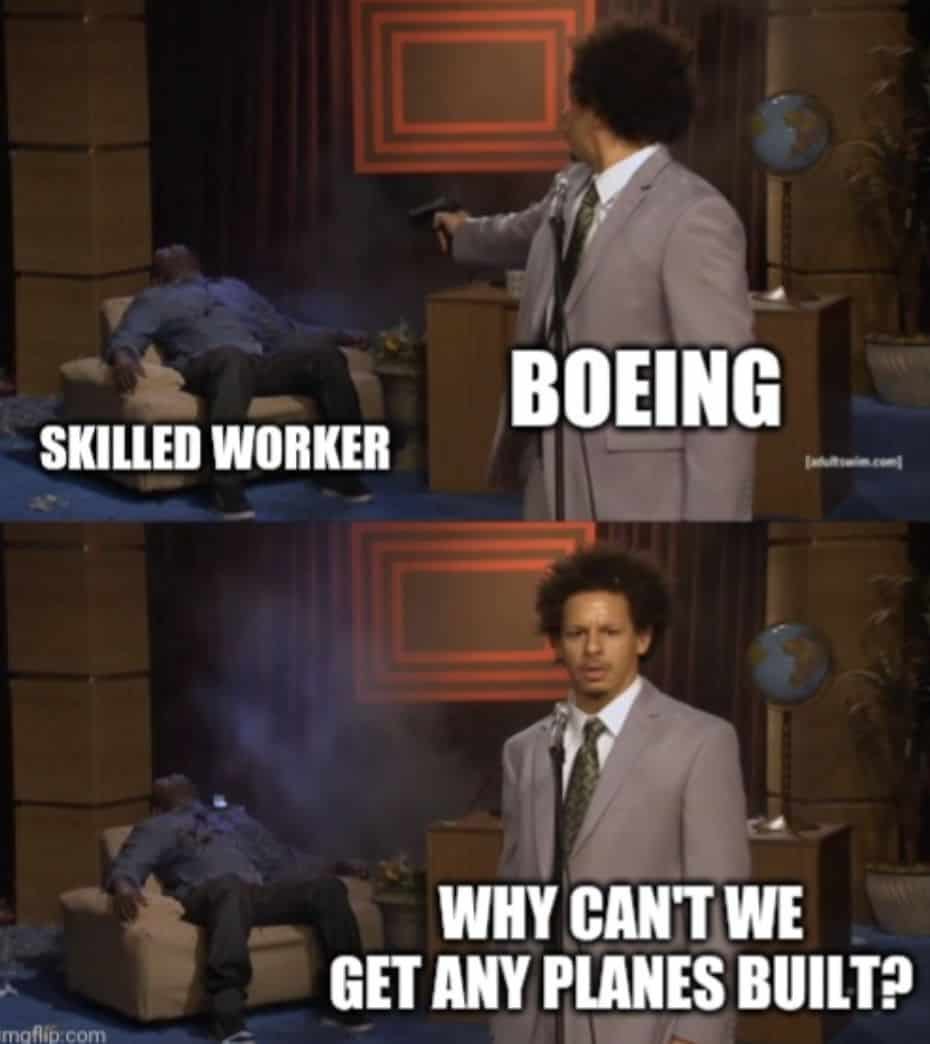
In the near term, the VLO scheme worked great: expensive workers in California, Kansas and Washington were replaced by cheaper less experienced workers in Oklahoma, Alabama and South Carolina without the benefit of legacy knowledge on long standing programs. Lower rates enabled more competitive bidding and higher profit margins on aging programs!
In the long run though these initiatives were a disaster. Boeing was doing everything possible to push it’s experienced top percentile engineering talent out the door while encouraging it’s oldest, most expensive and least productive employees to wait around in senior roles for “their package” all the while junior talent found itself unable to advance up the corporate ladder so sought greener pastures elsewhere (including, yours truly). Seriously, what could go wrong?
We’ll just buy the program
As it hollowed out it’s workforce, Boeing continued bidding future work based on the productivity it had from it’s previously battle tested workforce, despite it starting from scratch at the top of the learning curve. Compounding this, Boeing heavily leveraged its program accounting methods to allow it to aggressively bid Firm Fixed Price contracts by bidding into contracts for a large loss upfront hoping to make up the cost on future production.
This became the standard playbook for them, which enabled them to compete with Lockheed and Northrop on the military side and heavily leveraged their expertise using these program accounting methods on their large commercial programs. “We’ll just buy the program” was used on the tanker program, VC-25B (Air Force One) which has had over a billion dollars in contracts, MQ-25, T-7 trainer and numerous other large programs. It wouldn’t surprise me if it was also an integral element of Future Vertical Lift and other programs as well.
Since these programs took years to play out, oftentimes the hidden risk was buried in the accounting, only to proliferate when it couldn’t be hidden any more. As I mentioned, the new hires who were increasingly running these underbid programs oftentimes lacked the expertise to know what they were cutting out and if it mattered as managers ground them down to shed cost from these programs.
It is a standard heuristic in systems engineering that underinvesting early in a program in the requirements and engineering phases usually leads to defects and errors being caught later when they cost much more to fix as shown in Figure 6 below. This is the engineering corollary to the old medical saw “an ounce of prevention is worth a pound of cure.” Boeing would too often underinvest in up front systems engineering and make faulty assumptions about reuse from heritage programs based on the views of managers trying to meet cost numbers.
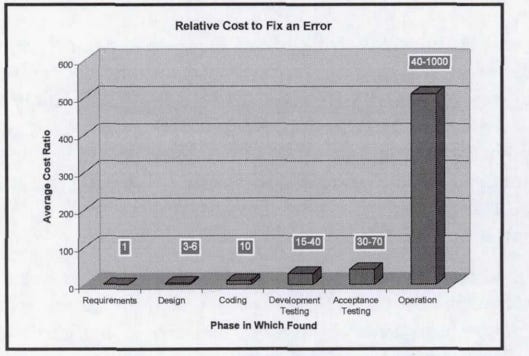
Couple this with a desire to replace rigorous testing with incomplete modeling & simulation or half-ass analysis (because testing is expensive) and you are setting a ticking time bomb.
For instance, on the CST-100 Starliner program’s first unmanned flight, Telemetry & Control (T&C) radios didn’t have adequate filtering to mitigate electromagnetic interference (EMI), leading to a loss of contact on orbit. This should have been caught as a a) a requirements gap during initial design or b) identified as a problem on the ground during ground testing but instead turned into c) a failure to make contact with the craft on orbit, complicating its first test flight. a) or b) would have been several thousand dollars or hundreds of thousands to low millions to fix on the ground. Instead it turned into a hundred million+ problem that caused an on-orbit failure, delayed the program and led to mass embarrassment and loss of customer confidence.
As I write this, a CST-100 Starliner capsule is stuck docked to the international space station indefinitely due to a combination of anomalous thruster behavior, abulia on the part of a risk averse NASA that as I’ve previously written, never fully recovered psychologically from killing 17 astronauts, and Boeing’s general lack of confidence in it’s design. The company may be stuck with the embarrassing alternative of marooning the two astronauts until as late as February when SpaceX is scheduled to send a dragon capsule up there anyways to retrieve them.
Ground control to Major Tom?
Who is Kelly Ortberg and why might he be different?
Now that I’ve laid out the all the problems in as much detail as the public record allows, let’s turn our attention to Boeing’s potential turnaround agent, Robert “Kelly” Ortberg.
At Rockwell Collins, Ortberg was known for taking a balanced approach. He eliminated a lot of the management perqs that separated executives from the workers and became intimately familiar with their product lines. He’s already said that he’s moving to Seattle so he can sit with the Engineering and Manufacturing rather than in the current corporate headquarters in DC. This is a sharp contrast from Dave Calhoun who never moved and charged the company for flights from his New Hampshire mansion.
There is a lengthy discussion on Aviation Week’s Check 6 podcast on his management style and background for those interested. TL;DR: very mid-western. He’s a workhorse, not a show horse, who works to build consensus from a lot of different stakeholders.
So far in his short tenure on the job Ortberg has focused mostly on trying to mend relations between labor and management. The 30,000+ IAM machinist’s union has signaled they are expecting a UAW like pay raise (40%+ over 5 years) this cycle, along with unfreezing pensions and better medical benefits. Their contract is set to expire September 12. Given the proximity to a close election and the potential economic impact, it is virtually certain that the Biden administration will call a “90 day cool off” period if a strike does go forward, which may buy him some breathing room, but he’ll still have to figure out how to move past this.
I mean, underpinning everything is that Boeing has a cultural problem. It has to redefine the values that define the company that have gone astray…I think Rockwell Collins has one of the absolute best cultures in the business, and I call it a balanced capitalism culture. - Kevin Michaels, managing director of management consulting firm Aerodynamic Advisory Aviation Week Check 6 podcast
Whatever agreement he comes to with the IAM will almost certainly become precedent for another contract with the aerospace engineers SPEEA union (yes, Boeing engineers in Washington state and a few other places are unionized, amazingly) barely two years from when the IAM contract is inked . It’s clear that controlling labor costs while increasing productivity and quality will be a three legged stool he’ll have to figure out how to not stumble off of.
What needs to be done?
The Boeing balance sheet is in tatters and overlevered from years of charge offs, its engineering workforce has been hollowed out, its reputation with customers is near an all time low and it suffers from tattered labor relations that could blow up any minute. Aside from all that Mrs. Lincoln, how’s the play?
I’ll lay out a couple key strategic objectives that I would take on if I were in Ortberg’s shoes:
Labor
(already in work) Reach a fair agreement with the labor unions that doesn’t let them bankrupt the company and yet keeps them off your back for a couple years so you can deal with longer term problems. One possible solution would be to put a large portion of their unfrozen pensions in Boeing stock with direct exposure to the upside, so they have skin in the game.
Cull the executive and managerial ranks with a focus on cultural fit. Bring in new leadership from “new aerospace” or tech that has a different mindset.
Get to manager and executive ratios more in line with industry. Simplify org structures which became more complicated in last few years and emphasize accountability. Pare back the number of lawyers, HR professionals and other back office staff that don’t add value to the product.
Change the companies internal processes for ranking and rating employees to create more accountability and create less room for poor performers to hide. When I worked there, my annual rating was over 40 different metrics from 1 to 5 - too complex for viable feedback at scale and easy to obscure poor performers. Juxtapose this with when I was a manager at Raytheon where we literally had four rankings “Needs Improvement”, “Meets Requirements”, “Exceeds” and “Far Exceeds”. Boeing needs to eliminate complexity to make it easier to single out high performers and identify poor performers and show them the door.
Focus the Business and Unlever
Fully sell off Boeing’s stake in the United Launch Alliance and use the proceeds to repair the balance sheet.
Divest parts of Boeing’s sprawling defense portfolio that might make sense - perhaps it’s time for Boeing to get out of the space business altogether and focus just on airplanes? The cash proceeds from these businesses could pay down the balance sheet and focus the company on doing a few things well.
Go Vertical and repair the cash flow and balance sheet
Use the proceeds from divestment to reintegrate/in source Spirit Aerosystems or other critical suppliers. The “fee on fee” savings from going vertical will in the long run improve program profitability and reduce hidden risk
Lobby Investment banks or government (Congress or state legislatures) for help with refinancing debt, potentially using the export/import bank of other agreements as collateral to pay off loans.
Execute and look to the future
Get the 777x through FAA certification and into customers hands in 2025 at all costs, avoiding any more schedule delays and look for opportunities to bring schedule.
As soon as cash flow allows, lay out a vision for and restart the Middle of Market (MoM) aircraft program which will serve as a mantle for hiring top engineering talent and give the company a future purpose rather than just living off the laurels of the past. Great engineers join a company for an opportunity to work on something really hard and Boeing needs a challenge to sell them on.
Admittedly I’m spitballing here a bit, but any of these things could help the company a lot in my humble opinion. Execution however always trumps strategy and culture eats them both for breakfast. The hardest part here will be changing Boeing’s culture back to what once made it great and away from the short term focused bean counting mentality it was infected with from McDonnell Douglas. That will be the greatest challenge for Mr Ortberg and a lot of it will depend on what executives he hires to fix it.
Boeing is a crown jewel of American industry and when it does well, America does well. We should all be rooting for her and for Kelly Ortberg’s success.
Further Reading

Want to know the story of how Airbus went from 15% market share to 35% and put Boeing on it’s heels by the early 90s? Read the story of Airbus’s legendary salesman John Leahy and how he changed the game of selling airplanes.

While Peter Robison is a cynical liberal who views Reaganomics as the reason behind the downfall of so many once great American companies (hint, it’s not) he gives an amazingly detailed account of the strategic mistakes that wrecked Boeing. From the boardroom intrigue surrounding the failed merger with McDonnell Douglas to the detailed engineering review boards following the Max disaster and the “crisis communications” coaching for Muilenburg that didn’t contain the damage, he covers it all in amazing detail for an outside. Truly a great read.
Great essay. I can’t help but see parallels between Boeing and GE and Enron. The latter two were laid low by financial engineering and accounting trickery. I have found that accountants and financial managers are, like lawyers, very often unable to think through the second order consequences of their actions.