
Winning the 10,000th shot
The last thirty years conditioned us to think that military advantage came from better platforms. The next thirty may be decided by better production systems.

“They are producing over 100 missiles a month…compare that to the six or seven interceptors that can be built a month”- Marco Rubio
Secretary of State Marco Rubio made a very poignant observation a couple months ago during the height of the Iran conflict: that the Iranians were outproducing our defense industrial base by more than a factor of ten in the interceptors vs ballistic missiles race. While Iranian missiles may have poor quality, poor precision and low reliability, the high cost of collateral damage in the industrially important and extremely vulnerable Persian Gulf (which I talked about in a prior post) gives them an unfair advantage. They don’t need most of their missiles or drones to hit: they just need to make one lucky shot to incur billions in economic damage upon us and our allies. Every missile and drone which looks like its on course must be intercepted - and with too few multi-million dollar interceptors, stores are running low.
In an era of autonomous systems, software-defined weapons, and industrial-scale drone production, victory may depend less on the quality of the first shot than on the ability to fire the ten-thousandth.
We spent decades believing the decisive military advantage belonged to whoever built the best weapon. Ukraine, Iran, and the Red Sea suggest something different. The decisive advantage may belong to whoever can replace yesterday's losses before tomorrow's battle. In an era of autonomous systems, software-defined weapons, and industrial-scale drone production, victory may depend less on the quality of the first shot than on the ability to fire the ten-thousandth.
In this piece, I’ll talk about how the paradigm of modern warfare has changed in favor of those who can produce attritable mass, at scale with acceptable performance. This is a paradigm that we are, in many respects, just now waking up to.
“Good enough” performance
For the past three decades, we have spent literally trillions of dollars chasing 1% greater Probability of Kill (Pk) from our missiles, that last decibel of RCS from our stealth aircraft, that last .1% of lifetime reliability from our satellite systems. The Pentagon’s systems engineering apparatus became obsessed with chasing what many of my chief engineer mentors derided as that “last .1 dB of performance” - dramatically trading cost and schedule for an unwavering commitment to meet every single objective requirement - and then some.
In peacetime and low intensity conflict, this was a great way to convince ourselves we had an overwhelming technical advantage. But meanwhile our production capacity languished as we went from building Honda civics to Ferrari Testa Rosas. Take for example something near and dear to my heart - Anti-Radiation missiles. These are the primary workhorse of our Suppression/Destruction of Enemy Air Defenses (SEAD/DEAD) mission we do in the opening days of a war to establish air superiority. As the graphic below shows, these missiles literally cost 50x now what they did when first fielded sixty years ago. Needless to say, they are not 50x more capable.
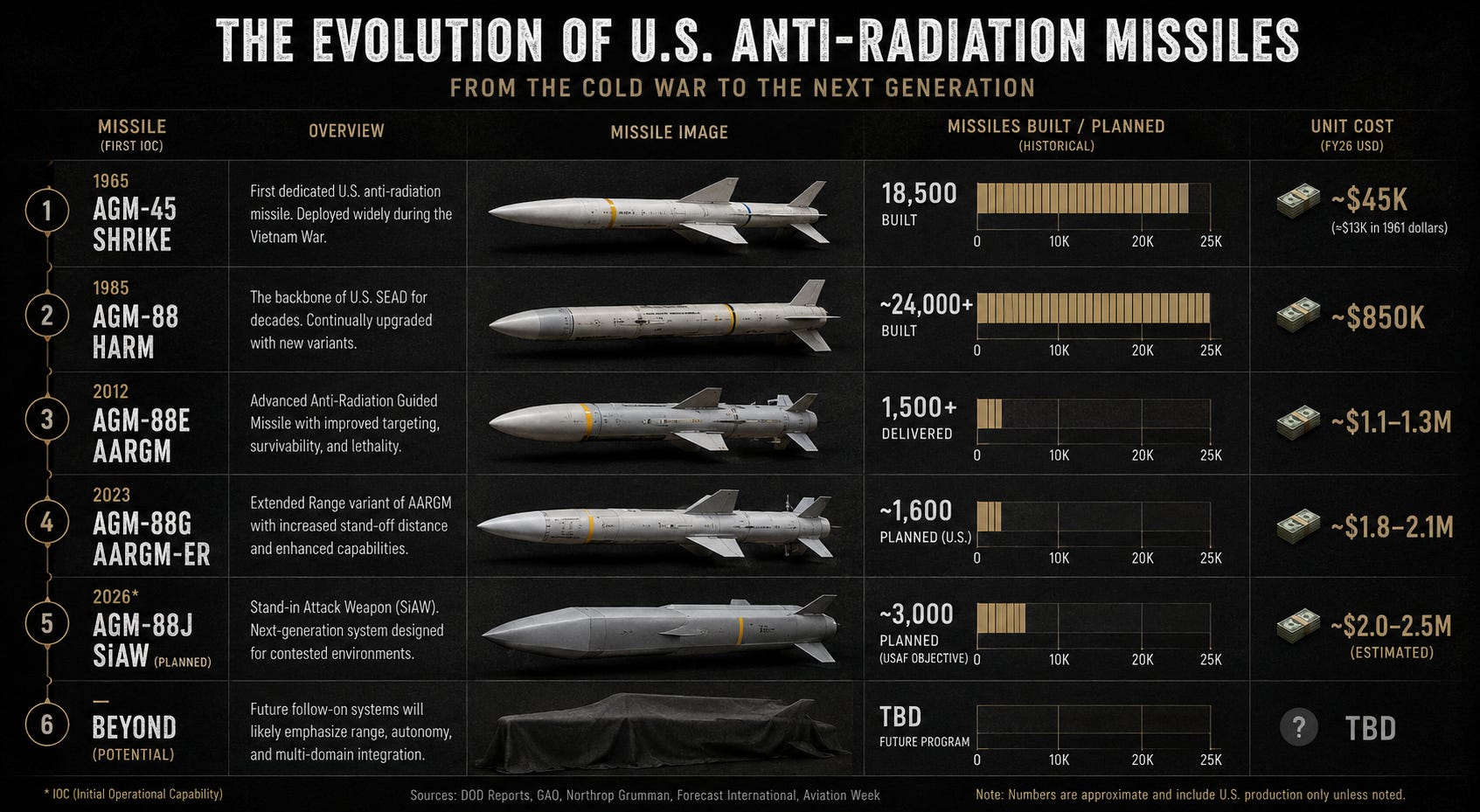
We fired over 2000 HARM missiles during Gulf War I, over half in the first week. Hundreds of these are also used every year in training missions or need to be retired because they are past their shelf life. Who knows how many were used in the recent Iran war (the exact number is likely classified but it wouldn’t surprise me if its in the hundreds). If we run out of these before the enemy runs out of radars, jammers, ground controllers and decoys that we need to sanitize from the battlefield of today to establish spectrum dominance, we have problems. All of this because we made no compromise on performance to the point where we couldn’t build enough to make a difference.
Instead of debating whether Missile A is 15% better than Missile B, we should have been asking: how do we build a production system that can adapt and scale faster than our adversaries? In an age of sustained attrition, that may be the capability that matters most.
The solution doesn’t always have to be McLaren expensive. At CX2 we conceived Vadris, which takes a portion of this mission set and puts it on a FPV drone for low thousands of dollars a unit. We can assemble them by the hundreds and scale up to thousands with just more seats for technicians. The answer to attritable mass with more attritable mass. That’s how we win in this paradigm. It’s time for us to think differently and think about how we build things at scale - something the US used to be really good at, but somehow lost our way.
Production vs Precision
The most obvious example of us being on the wrong side of this cost curve is in missiles and drones vs interceptors. As the graphic below shows we are as much as a factor of 100 off of the Iranians on cost. Sure: 90% of the time their systems are crap and can be easily intercepted or fail in flight, but if one Shahed can shut down a multi-billion dollar refinery indefinitely eventually the cost asymmetry becomes an overwhelming advantage. As Stalin said: “quantity has a quality all of it’s own.”
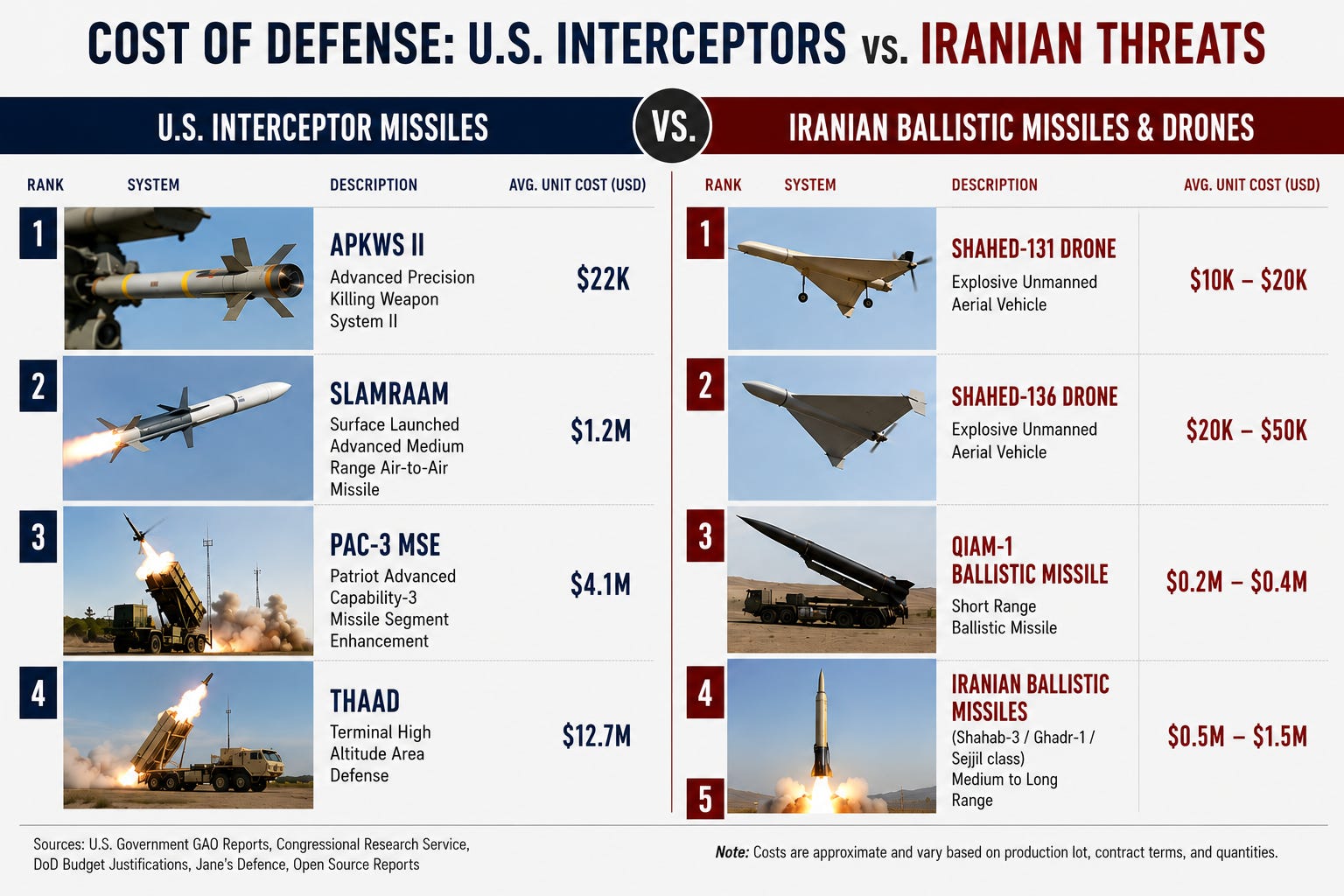
The only thing that the US has that’s close to the interceptors in cost is APKWS II, a laser guided rocket. The Advanced Precision Kill Weapon System II (APKWS II) has emerged as one of the most economical tools in the U.S. counter-drone arsenal. By converting standard 70mm Hydra rockets into precision-guided munitions, APKWS II delivers a guided interceptor for roughly $20,000–$40,000 per shot—an order of magnitude less expensive than missiles like the AIM-9X, PAC-3, or THAAD. Today it is fielded on a wide variety of platforms including AH-64 Apache helicopters, USMC AH-1Z Vipers, UH-1Y Venoms, F-16s, and F-15E Strike Eagles, where it has proven effective against slow-moving drones and cruise missile-class targets. Yet despite its attractive economics, APKWS II is not a panacea. It has less than 10 km engagement range and more importantly, every intercept demands a manned aircraft already airborne on combat air patrol, consuming flight hours, tanker support, maintenance, and exposing valuable crews and aircraft to risk (we saw that risk become an issue during the recent shootdown of an Apache by the Iranians over the Persian Gulf). While APKWS II dramatically improves the cost exchange ratio on a per-shot basis, it does so by substituting missile cost with sustained operational cost, limiting its scalability as a long-duration air defense solution.
Historical analogs
Interestingly enough, it’s usually the US that has won through the production advantage. During WWII, US tanks sure as the Sherman were inferior to the Tiger and Panzer tanks of the Germans, but we were able to produce them in much larger numbers. US shipyards famously could build one liberty ship in a day. The Germans and Japanese couldn’t match our industrial might.
The Cold War wasn’t won solely because of individual weapons. It was won because the United States could sustain technological and industrial competition over decades and we eventually bankrupted the Soviets that were trying to keep up. After Desert Storm, we became enamored with exquisite precision systems because we were fighting opponents who couldn’t impose meaningful attrition. We often found ourselves in short, low intensity conflicts where the desire for lower collateral damage outweighed the need for overwhelming massive force. Ukraine, the Red Sea, and now Iran-Israel remind us that quantity has returned and we are now facing attritable mass enabled by consumer electronics.
This is not a substitute for quality - you still need the missile to actually take off and hit its target most of the time. It’s just that “two 9s” of quality or even “one 9” is good enough - you no longer need “five 9s” like we were hammered on to chase during the Six Sigma era of the early 2000s. And the threshold of cost and expertise required to achieve this has dropped in recent decades like the cost of your flatscreen TV. The work of the most brilliant minds two generations ago is now open source and can be recreated via mail order with Chinese parts.
Defense and the other side of Perkins’ Law
Investors have often looked at defense firms as a deep tech play, protected by Perkins’ law - the observation from Tom Perkins’ (co-founder of Kleiner Perkins) that technical risk is inversely proportional to market risk. However, in the era mass production of cheap consumer drones and electronics that meet the minimum threshold of performance, perhaps production capacity is a more important metric?
Sure - product market fit is still important. You can’t sell an Edsel. But when I walked the floor at SOFweek recently, I founded that no less than six companies present (by my count) were building and marketing drone interceptors. I’m sure the exact number is ten times that amount. A solution to a problem may be a ticket to entry, but a lot more people are capable of solving that today.
So what becomes the differentiator nowadays, then? Perhaps in our rapidly changing world, its the company itself and it’s ability to acquisition OODA loop: the ability to rapidly see a need, build a product to fill it and scale to production massively.


Defense companies shouldn’t be valued solely by their products or even as manufacturers. They should be valued as production systems.
That means asking questions like:
How quickly can they double output?
How many suppliers can they qualify?
How much engineering change can they absorb without shutting down the line?
How automated is production?
How quickly can they scale their down range support?
How rapidly can they field the next iteration?
Can they manufacture in a distributed fashion if a factory is attacked?
Asking these questions, far too many of our legacy defense contractors fail badly. I doubt that you could quadruple the production of the PAC-3 line in three years if you tried, let alone absorb a physical attack on one of its factories. But a drone interceptor line could likely be scaled much faster than that with fewer problems. And eventually you can take that same approach, leverage its success and apply it to more complex problems - like ballistic missile interceptors.
Bringing this all together
When it comes to our weapons of war, the whole is greater than the sum of its parts. During the last few decades, we have relied on exquisite assets that are few in number and optimized for performance to fight our wars. Our defense industrial base has molded itself to this business model - optimizing for cost plus contracts with long development cycles and low production rates. There was low or no compromise on performance in the name cost, schedule or scalability. The end result is a system that builds incredibly capable systems at a snails pace. Meanwhile, the consumer electronics revolution has brought the price down of components and removed barriers to entry to the point where hundreds of new drone players have popped up.
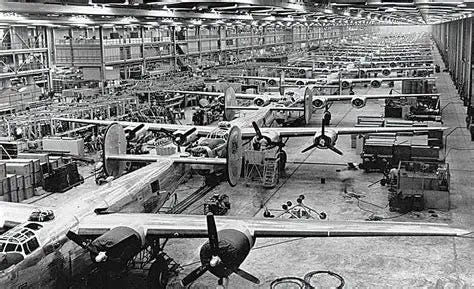
As the weapons of war shift from custom crafted to produced at consumer scale - something that happens every time we shift from piece time to war time in the industrial age - what we value in defense primes will shift from best value to lowest price technically acceptable, and the companies will be evaluated on different things. The last 9 of reliability from a product will matter less then the ability to 10x production of that product in a short period of time. The quality attributes we emphasize will change: ease of adaptability and extensibility will outweigh technical performance once you’ve achieved “good enough”. Companies will be judged on how fast they can field new products and iterate moreso than the quality of version 1.0 of those products. Hardware will start to look more like software.
In conclusion Our ability to take a shot, learn and adapt from it, then stay in the fight for the 10,000th shot, will matter more than our ability to knock out our opponent on the first swing. This is how we win.
There's a cost, technology, human war fighter triad that needs balancing for sure. It seems high time for adjusting for cost in interceptor design. Especially for the low altitude drone problem set.